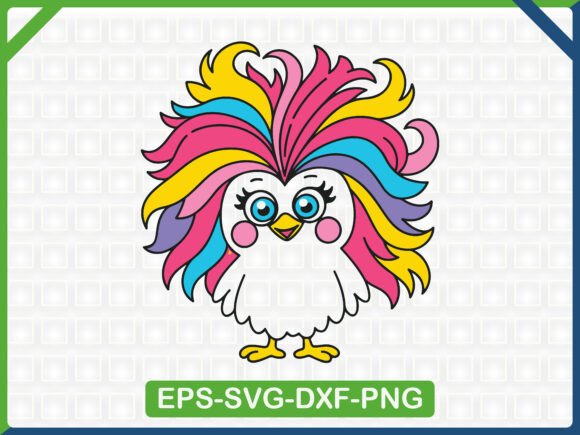
Funny Crazy Chicken SVG Design
First Impression: Playful, Bold, and Instantly Recognizable
When I opened the Funny Crazy Chicken SVG Design, my first thought wasn’t “cute” or “trendy”—it was “this will land.” The chicken has exaggerated eyes, a slightly lopsided beak, and wings flared like it just heard terrible news. There’s no subtle charm here—it’s joyful chaos in silhouette form. As an embroidery designer who’s stitched hundreds of animal motifs for baby onesies, boutique aprons, and craft fair totes, I appreciate how clearly this design communicates personality at a glance. It reads well even at 3 inches tall—no tiny details competing for attention, no fussy linework that’ll vanish under satin stitch. That’s not luck; it’s smart graphic discipline.
A Real-World Test: Embroidering It on a Linen Kitchen Towel
Last week, I used the Funny Crazy Chicken SVG Design to create a set of embroidered tea towels for a local kitchenware pop-up. Why a towel? Because it’s unforgiving: linen shifts, thread tension shows, and dense fill areas can pucker if stitch density isn’t balanced. I converted the SVG to a machine embroidery design using standard digitizing practices—no auto-trace shortcuts—and ran it on medium-weight cutaway stabilizer. The result? Crisp edges, clean satin-stitched outlines, and a fill stitch body that held shape without stiffness. Customers picked up the towels immediately—not because they were “on trend,” but because the chicken felt handmade, warm, and human. That’s the quiet power of this design: it doesn’t try to be perfect. It tries to be *present*.
Where It Shines (and Where It Needs Care)
The Funny Crazy Chicken SVG Design excels in custom apparel and small-batch merchandise—especially on structured, stable fabrics. Think sweatshirt embroidery for a farm-themed boutique, embroidered patches for kids’ backpacks, or tote bag designs for a poultry-loving coffee roaster. Its bold negative space and generous line weight make it forgiving on textured fabrics like canvas or terry cloth. On baby embroidery? Yes—but size matters. At 2.5 inches wide, it reads beautifully on onesie sleeves or bib corners without overwhelming delicate proportions.
That said, proceed with care on stretchy fabric (like jersey tees) or curved surfaces (caps). Without proper stabilization and careful hooping, the wingtips and eye details can distort. Avoid shrinking it below 2 inches unless you’ve tested the embroidery file on scrap first—the beak and comb lose definition fast. And while it works on dark fabric, test thread colors: a high-contrast white or yellow pops best, especially since the design relies on shape—not shading—for impact.
What It Does for Your Craft Business
As an Etsy seller and small shop product developer, I look beyond “will it stitch?” I ask: “Will it sell?” This design builds trust quickly. Its humor feels authentic—not forced or algorithm-chased—so customers assume care went into the finished product. When paired with quality stitching and thoughtful placement (e.g., centered on a pillow cover, off-shoulder on a relaxed-fit tee), it elevates a handmade product from “nice” to “I’d gift this.” That perception boosts perceived value, supports premium pricing, and encourages repeat buyers who recognize your brand’s playful consistency.
It also performs well in digital contexts: as a printable mockup for your Etsy listings, as part of a holiday embroidery bundle, or even repurposed as a simple graphics asset for social media banners. Just remember—if you’re selling physical embroidered items featuring this design, confirm licensing terms before listing. The product description says it’s ideal for “many tasks, whether for your special day or any other occasion,” but commercial embroidery rights aren’t implied by versatility alone.
Practical Designer Notes You’ll Actually Use
- Always test first: Run the embroidery file on scrap fabric matching your final project’s weight and stretch. Linen behaves differently than cotton poplin—even with the same stabilizer.
- Check stitch density: If your digitized version feels heavy in the body area, reduce fill density slightly. Over-stuffing makes towels stiff and baby clothes less snuggly.
- Hoop size matters: The original SVG scales well, but don’t assume the embroidery file fits your smallest hoop without verifying. A 4x4 hoop is safe for most versions under 3.5 inches.
- Inspect small details: Zoom in on the eye and beak in your embroidery software. Are corners sharp? Is there stray running stitch? Clean vectors don’t always translate to clean stitches.
- Mock it in black and white: View your design on light and dark backgrounds. Does the chicken “read” equally well on navy denim and ivory linen? If not, adjust thread contrast—not layout.
- Stabilizer choice is non-negotiable: Cutaway for knits, tear-away for stable wovens, and fusible + tear-away for lightweight fabrics like chambray. Skipping this step undermines even the best Funny Crazy Chicken SVG Design.
- Confirm dual use: If you plan to sell both the digital embroidery file and finished embroidered products, double-check license scope. Graphics assets and commercial embroidery rights often live in separate legal buckets.
Final Thought: Not Just a T-Shirt Design—A Personality Anchor
This isn’t just another T-Shirt Designs download. It’s a personality anchor—a visual shorthand that tells customers, “This shop gets joy, simplicity, and craftsmanship.” Whether you’re embroidering a single personalized gift or building a full line of farm-fresh merchandise, the Funny Crazy Chicken SVG Design holds up because it respects the craft: it’s built for clarity, not clutter; for stitching, not just scrolling; for real hands making real things. Use it thoughtfully, test it honestly, and let its cheerful absurdity do the rest.